

He Made It Sloweron Purpose
Every electric skateboard on the market competes on speed, range, and power. Alexis Chabat built the one that competes on feel — and it meant leaving things out.
Behind the Story


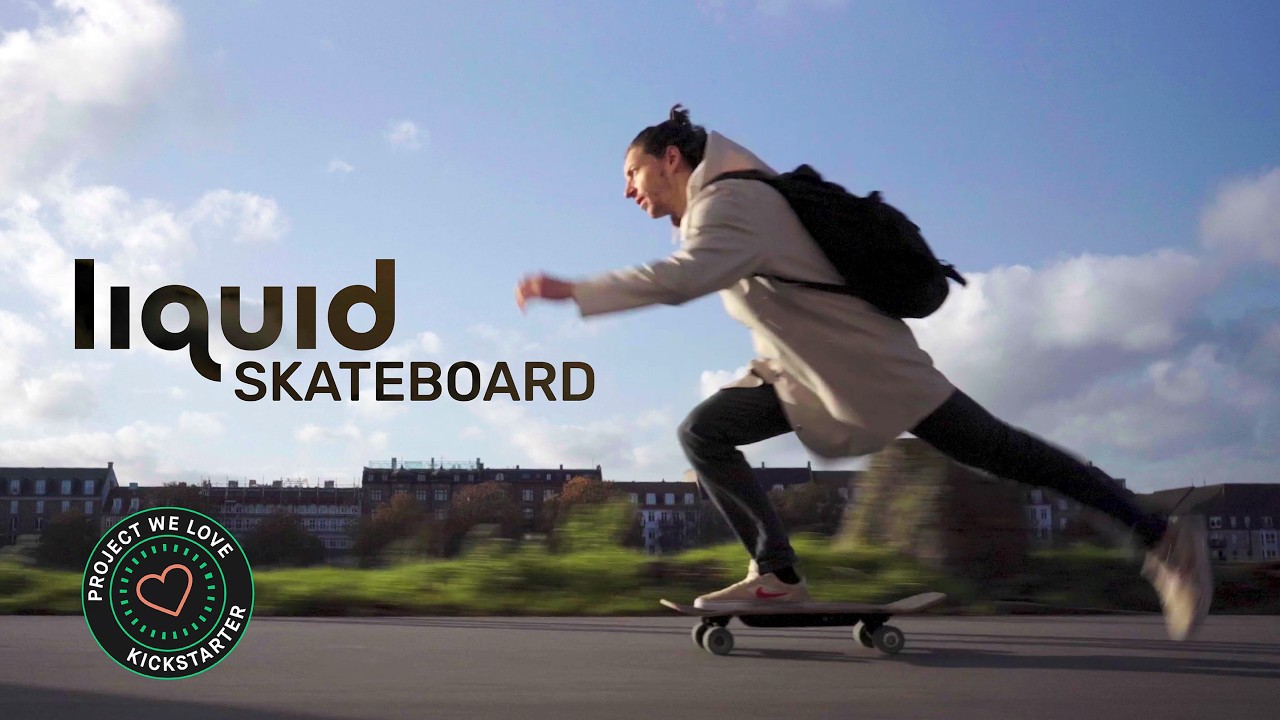
The spec sheet for a Liquid Skateboard looks like a loss.
About 22 km/h top speed. Roughly 12 km of real-world range. Meepo, Backfire, Exway, Evolve — every established player in a market worth $4.1B and growing 12.1% a year — will beat those numbers, and they'll beat them loudly, because that's the axis the whole category races on.
Alexis capped them anyway. Not because he couldn't build faster. Because he'd ridden the faster boards and found they'd traded away the only thing he actually wanted.
What was missing
Alexis had been skating for years before he started testing electric boards. He tested nearly all of them. And the same three complaints kept surfacing:
The remote felt unnatural — a device between him and the board.
Acceleration from a standstill, no push required, felt like cheating.
And his feet were effectively glued in place, locked into a stance rather than moving with the ride.
Individually, minor. Together, they described something specific: these were vehicles that happened to be shaped like skateboards. The technology hadn't enhanced the ride. It had replaced it.
I just wanted something
that felt real under my feet.
That sentence is the entire product brief, and it's worth noticing what kind of brief it is. It isn't a feature request. It's a description of a feeling — which is much harder to build toward, because you can't verify it in a lab. You have to go ride.
So he did. Dozens of prototypes, each one a test of a single question: does this still feel like skateboarding? Power delivery, board flex, weight distribution, how the motor behaves when you push off. Most of the work was tuning things down rather than up.
Then friends started asking to borrow the boards. Strangers started asking what it was. That's the signal that turns a personal project into a company — not a market study, but people wanting the thing out of your hands.

Early design iterations
The market he was betting against
Alexis didn't build from a market report. He built from what he could see on the street: how people actually move through cities, how skaters actually ride, what he wanted and couldn't buy.
But it's worth understanding the field he stepped into, because it makes the choice sharper.
Electric Skateboard Market
Global market size, growth rate, and structure
Market Summary
- Study period
- 2025–2031
- Base year
- 2024
- CAGR
- 12.1%
- Market size 2024
- $4,094.56M
- Market size 2031
- $9,108.49M
Market Growth
Market Structure
Major Players
Source: ReAnIn Electric Skateboard Market Report, 2025, study period 2025–2031.
Two things stand out.
The category is fragmented. No one owns it. In a consolidated market, a small entrant competing on feel gets crushed by distribution. In a fragmented one, a genuinely different product has room to find its riders.
Everyone is racing on the same axis. Scan the competitive set and the marketing is nearly interchangeable: top speed, watt-hours, hill grade, range. When every competitor optimizes the same variable, that variable stops being a differentiator and becomes table stakes — and the unclaimed ground is wherever nobody is looking.
Skateboarding surged during COVID and cooled afterward. What didn't change is the underlying want: a way to move through a city that's light, simple, and free. Most electric boards deliver power. Very few deliver that.
Alexis's instinct got there first. The data just agreed with him.
Good once, then good every time
A prototype that feels perfect under one person's feet is a demo. A product is a board that feels that way under the thousandth rider's feet, built by people who weren't in the room when you figured it out.
That gap is where most hardware projects quietly end.
After the Kickstarter closed, Alexis spent the following year on the unglamorous half of the work: setting up manufacturing processes, building tooling from scratch, testing suppliers, refining assembly methods, learning the supply chain from the inside. Every new fixture and batch test moved the board from good once toward good every time.
The performance he settled on:
- ~22 km/h (~13.7 mph) top speed
- ~12 km (~7.5 miles) real-world range
- Light enough to carry without thinking about it
- A ride that behaves like a traditional board
Read that list next to any competitor's and Liquid loses three out of four. That's the point. Each number is a deliberate ceiling, chosen because raising it would have cost weight, or bulk, or the specific responsiveness that makes the board feel like a board.
Dieter Rams built a career on four words — less, but better. The older version of the idea, from Saint-Exupéry, is that a design reaches perfection not when there's nothing left to add, but when there's nothing left to take away. Both are easy to quote and brutally hard to practice, because subtraction doesn't demo well. Nobody puts what we left out on the box.
The verdict came in slowly, the way real verdicts do. The first 200 Kickstarter boards shipped. Riders put them through actual daily use. The reviews followed.


Components and materials
The unglamorous middle
The honest version of this chapter is that going from a working prototype to a repeatable product is the least photogenic work in hardware, and the reason most great prototypes never become products. Alexis had the engineering. What scaling demanded was a different capability entirely — suppliers, tooling, quality gates, freight, certifications — none of which is skateboarding.
Manufacturing Partners
– Approved Vendor List (AVL)
– Material Standards & Tolerances
– Lead Times & Minimum Order Quantities
– Standard Operating Procedures (SOPs)
– Assembly Jigs, Tooling, Fixtures
– Ride Testing Batches
– Incoming Inspection Standards (IQC/AQL)
– End-of-Line Checks
– Safety Stock & Buffer Strategy
– Supplier Capacity Planning
Distribution Partners
– Packaging Standards
– Battery (UN 38.3) Shipping Compliance
– Inventory Management Systems
– Order Routing Logic
– Customs Brokerage
– Local Tax & VAT Handling (EU)
– FCC (US)
– PSE (Japan)
– Battery Transport Certification
Retail Partners
– Retail Display & Merchandising
– Return/Refund Workflows
– Demo Fleet Maintenance
– Regional Events & Group Rides
– Local Content Strategy

Preparing for scale
What comes next
There's a version of this story where the lesson is believe in yourself — and that version would be useless, because it gives the reader nothing to do.
The usable lesson is narrower. Alexis spent four years defending a feeling against a spec sheet, and the discipline that took wasn't confidence. It was the willingness to look worse on paper in exchange for being better in the hand, over and over, in a market where nobody was scoring that column.
Most products are built by adding until the deadline. A few are built by removing until only the thing that mattered is left. The second kind is harder to market and much harder to forget.
Turn ideas into something.
Liquid Skateboard scaled because Alexis knew exactly what he refused to compromise.